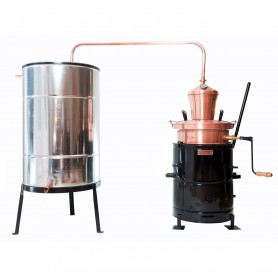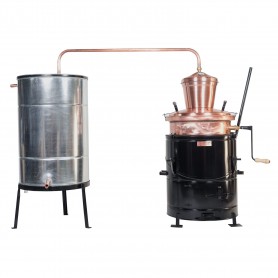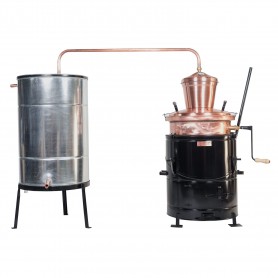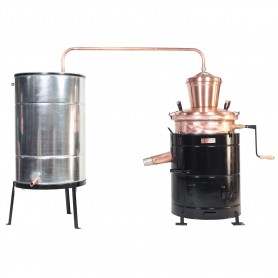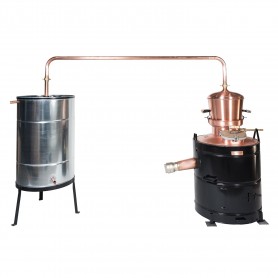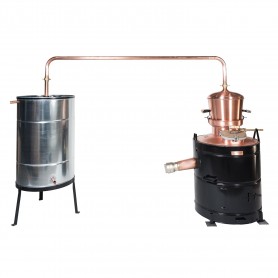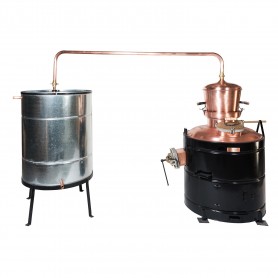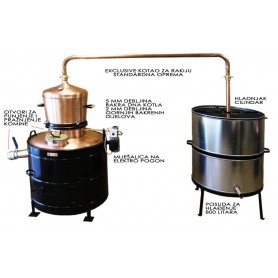

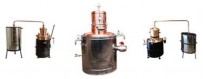








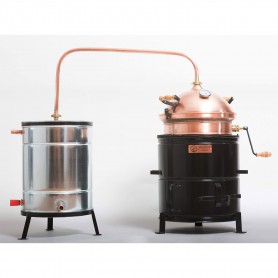
Hobby distilling pot still 35 liters with hand stirrer on solid fuel
€600.00
€666.67
-10%


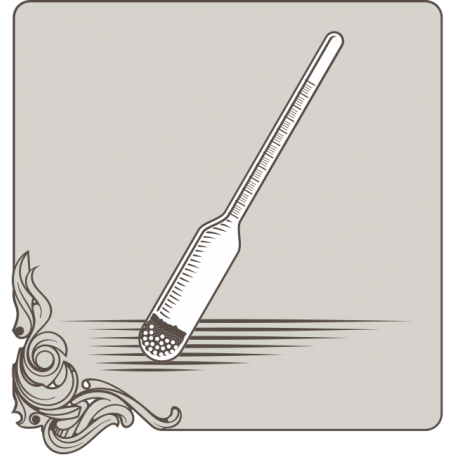


The highest quality brandy set (for fruit brandy) is an indispensable auxiliary tool for making good homemade brandy.
THE BRANDY SET CONTAINS:
1. An alcohol meter, i.e. an alcoholometer, is a device used to determine the volume (in percent) of alcohol in mixtures of alcohol and water and clear alcoholic beverages.
It will be useful when making (distilling) brandy and monitoring the increase in alcohol content (strength of brandy). It also helps when re-distilling (second distillation) brandy when you want to correct possible deficiencies in smell and color or when diluting soft brandy before re-distillation.
2. The pomace fermentation indicator is used to determine the end of fermentation of fruit pomace (pomace). To make brandy, it is necessary that all sugar is converted into alcohol because if the pomace is not fermented, we will get less brandy. Brandies that are distilled immediately after fermentation are of higher quality. The sugar reading on the indicator in Excel degrees must be ˚0e.
Why is it important to determine the end of the fermentation of fruit pomace (mashed plums)?
In order to start the distillation of brandy, it is necessary for all the sugar in the pomace to turn into alcohol. If the pomace has not fermented, we will get less brandy.
Scientific studies have shown that the moment of distillation of fermented plum pomace significantly affects the quality of brandy.
Brandies from later distilled pomace had a worse chemical composition and were rated lower in taste than pomace distilled immediately after alcoholic fermentation.
Therefore, it is necessary to correctly determine the end of the fermentation of fruit pomace.
How to take a sample for measurement?
The pomace in the container should be mixed. Take a quantity of 1/2 liter and filter (strain). The purpose of filtering is to separate the solid parts of the pomace and coarse particles of turbidity from the liquid part. The amount of sugar is tested in the liquid part of the pomace.
The filtered liquid should be shaken well to release carbon dioxide, which creates foam and releases gas bubbles. Slowly pour the liquid into a measuring cup of approximately 500 ml.
How do we measure the sugar in the sample?
Lower the dry indicator, holding it by the narrow end, into the liquid. The measuring cup must float freely in the measuring cup (it must not touch the bottom or walls). Wait until the measuring cup has completely settled (there should be no air bubbles on the walls of the measuring cup).
The eye line must be at the level of the surface of the liquid.
On a paper scale, we read the measured value in Oechsle degrees (on a scale of 0-40).
The wort boiling indicator is calibrated at 20 °C. If the liquid temperature deviates from 20°C, the reading is corrected as follows:
For every 1°C above 20°C, 0.2 °Oe is subtracted from the reading
Apple 4-12 °Oe
Pear 6-16 °Oe
Williams pear 10-16 °Oe
Cherry 12-20 °Oe
Plum 16-20 °Oe
Raspberry 4-8 °Oe
If the values of the fermented pomace are not within the specified ranges, this means that the fermentation has not been completed.
An additional check of the fermented pomace can be done as follows:
After measuring in the previously described manner, pour half a liter of liquid into a bottle of approximately 0.7 l (a bottle of wine or similar may be suitable) and add 5 grams of baker's yeast and shake well. Cover the bottle with a piece of cotton wool and leave it at room temperature (20-25°C). Stir occasionally over the next two days, making sure the liquid doesn't spill.
After two days, pour the liquid back into the measuring cup, wait for it to settle, and measure it with a must meter. If the value is the same as the first measurement before adding yeast, the alcoholic fermentation is complete and we can proceed with distillation. If the measurement shows a lower value, it means that the fermentation is not complete and we need to wait with distillation. We used yeast to stimulate fermentation to see if there was any unfermented sugar left in the must